Pile Metrics Guide
This guide outlines the various metrics used in our system, grouped into four main categories. Each section includes a description of the metrics along with a corresponding illustration.
1. Design Metrics
These metrics represent the planned or target values during the design phase.
- Design N (local distance unit):
- The planned northward coordinate measured in the designated unit (e.g., meters or feet).
- Design E (local distance unit):
- The planned eastward coordinate in the chosen unit of distance.
- Design Z (local distance unit):
- The planned elevation (vertical coordinate) using the designated unit.
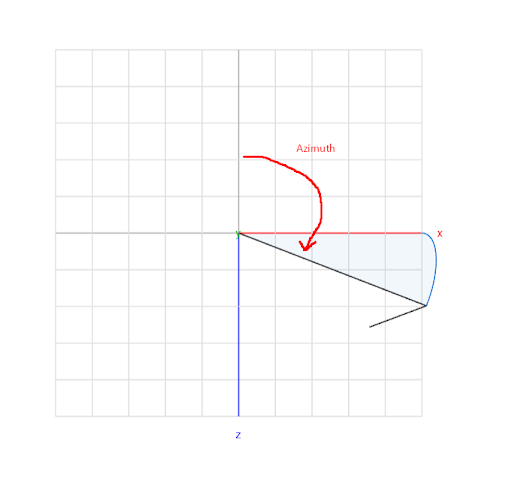
- Design Azimuth:
- The planned directional angle relative to true north.
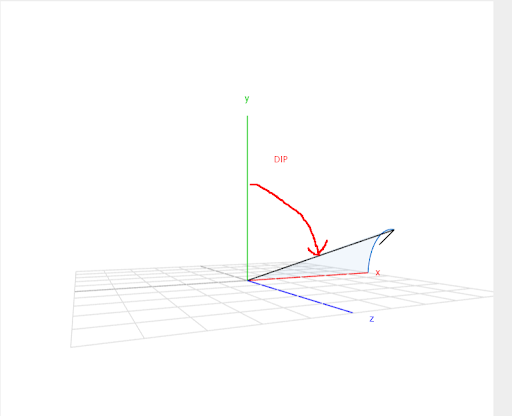
- Design Dip:
- The planned angle of slope (inclination) for the design.
Illustration:
2. Actual Metrics
These metrics capture data recorded by the machine during the operation process.
- Machine:
- Identifier or name of the machine used for the operation.
- Start Date Time:
- The exact timestamp when the hammer penetration begins.
- Start Date:
- The date extracted from the start timestamp.
- Start Time:
- The time extracted from the start timestamp.
- Stop Date Time:
- The timestamp indicating when the Pile Driver drives off the pile at a 1 ft tolerance.
- Stop Date:
- The date portion of the stop timestamp.
- Stop Time:
- The time portion of the stop timestamp.
- Duration:
- The total time elapsed between the start and stop of the operation.
- Start N (local distance unit):
- The north coordinate at the beginning of the operation.
- Start E (local distance unit):
- The east coordinate at the beginning of the operation.
- Start Z (local distance unit):
- The elevation coordinate at the start.
- Azimuth:
- The machine’s measured azimuth during the operation.
- Dip:
- The machine’s measured dip (slope) during the operation.
- End N (local distance unit):
- The north coordinate at the end of the operation.
- End E (local distance unit):
- The east coordinate at the end of the operation.
- End Z (local distance unit):
- The elevation coordinate at the end.
3. Survey Metrics
These metrics document the actual measurements obtained during the survey process.
- Survey Machine:
- Identifier of the machine used for surveying.
- Survey Date Time:
- The timestamp when the survey was conducted.
- Survey N (local distance unit):
- The measured north coordinate from the survey.
- Survey E (local distance unit):
- The measured east coordinate from the survey.
- Survey Z (local distance unit):
- The measured elevation coordinate from the survey.
4. Error Metrics
These metrics quantify discrepancies between the design, machine, and survey measurements, helping to identify and correct deviations.
- N Error (local distance unit):
- The error in the north coordinate (difference between expected and measured).
- Forward/Back Error (-Back local distance unit):
- Error along the forward/backward axis depending on the direction the machine is facing; negative values indicate a backward deviation.
- E Error (local distance unit):
- The error in the east coordinate.
- Left/Right Error (-Left local distance unit):
- Error along the left/right axis depending on the direction the machine is facing; negative values indicate a leftward deviation.
- Z Error (local distance unit):
- The vertical (elevation) error.
- Azimuth Error:
- The difference between the designed azimuth and the measured azimuth.
- Dip Error:
- The difference between the designed dip and the measured dip.
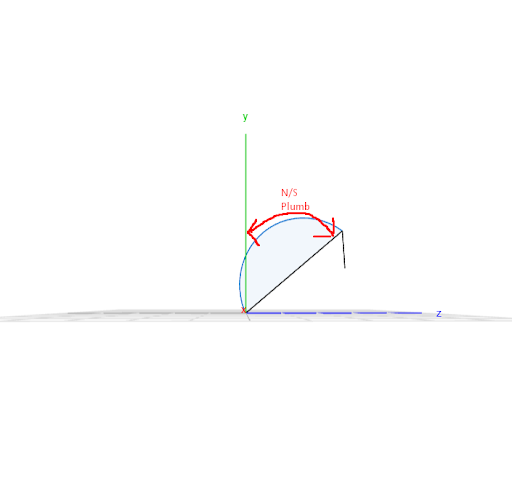
- N/S Plumb:
- The plumb (degrees) error measured in the north/south direction.
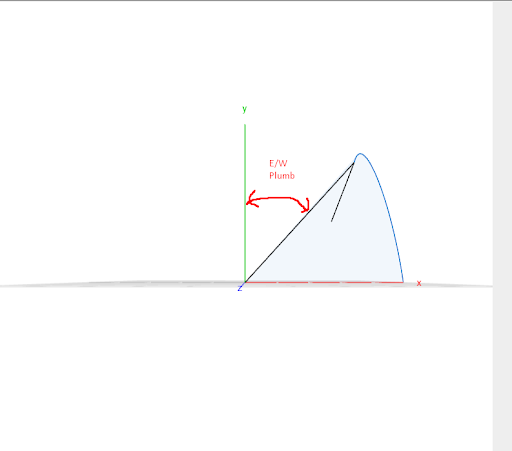
- E/W Plumb:
- The plumb (degrees) error measured in the east/west direction.
- Survey N Error (local distance unit):
- The error between the survey and design values for the north coordinate.
- Survey E Error (local distance unit):
- The error between the survey and design values for the east coordinate.
- Survey Z Error (local distance unit):
- The error between the survey and design values for the elevation coordinate.
Illustration: